
Building blocks are one of the few toy categories that adults buy for themselves, collect for decades and talk about online every single day. That makes it a wonderful market for a new brand, and a crowded one. A great model in a box is no longer enough. The independent brick brands that last have something else: a clear niche, a name people remember, a recognisable design language, healthy margins and a community that shows up on launch day. This guide covers all of it, in the order you'll actually need it.
The short version
- Pick a niche you can own, not a category you have to fight for.
- Name it, check it, protect it before you print a single box.
- Design a signature so people recognise your sets without reading the logo.
- Plan a product ladder: an entry set, a hero set, a collector set.
- Price from your costs, with room for retailers even if you sell direct at first.
- Get your safety paperwork right for every country you ship to.
- Build the audience before the product, then launch to people who are waiting.
Already know your brand and need the production side (prototypes, volume runs, custom packaging)? Read our companion guide: How to launch your own brick kit brand, from one MOC to boxed sets.
Why it's a good time to start a brick brand
Ten years ago, launching a construction toy brand meant tooling your own moulds, which costs a fortune, or convincing a factory to take a chance on you at minimums only established companies could afford. Three things have changed since then:
- Compatible parts are a commodity. Tens of thousands of part-and-colour combinations are available in any quantity, from one set to thousands, so a design is no longer limited by what you can afford to mould.
- Design tools are free. Studio, Mecabricks and the LDraw tools let you design, render and write building instructions on a laptop, without a single physical brick.
- The audience is already gathered. Adult fans of brick building fill Instagram, YouTube, Reddit, Discord and fan events. You don't have to create the hobby; you have to find your corner of it.
The barrier to making a set has collapsed. The barrier to standing out has gone up. That's why most of this guide is about brand, not bricks.
Step 1: Find a niche you can own
"Cool sets for adults" is not a niche. "Modular European shopfronts at a consistent scale" is. So is "botanical displays for people who've never built before", "retro computers and game consoles", "historically accurate trains", "desk-sized architecture of brutalist buildings" or "mechanical kinetic sculptures". A good niche has four qualities:
| Test | The question to ask | Red flag |
|---|---|---|
| Passion | Could you design 20 sets in this theme without getting bored? | You picked it only because it's trending. |
| Gap | Do fans of the theme complain that nobody makes what they want? | Three big brands already release sets in it every year. |
| Reach | Can you name five places where these people gather online? | You can't find a single hashtag, subreddit or forum. |
| Freedom | Can you design it without anyone else's characters, logos or vehicles? | The idea only works with a famous film, game or car brand on it. |
The last test matters more than people think. Licensed themes look like a shortcut, but without a licence you are building a business on something you don't own and can lose overnight. Original themes are slower to start and impossible to take away from you.
💡 A quick way to validate a niche
Design one model in the theme and publish it as a MOC with downloadable instructions on the BuyMeBricks MOC Store. Builders can order every part in one click, and your dashboard shows views, sales and earnings. If strangers buy it with no promotion, you've found something. Our guide on selling your MOC walks you through it.
Know who you're designing for
Write one paragraph describing your buyer. Not "adults 18 to 65", but a person: "She's 34, works in an office, builds on Sunday evenings to switch off, displays everything on one shelf in the living room, and buys two or three sets a year, mostly as gifts to herself." That paragraph will settle dozens of decisions later: the part count, the box size, the price, the tone of your captions, even the colour of your logo.
The brick world has a few distinct buyer types, and they rarely want the same thing:
- Display collectors want detail, accuracy and a clean footprint on the shelf. They'll pay for parts count and exclusivity.
- Relaxation builders want a calm, satisfying build of two to six hours, a beautiful result and instructions that never frustrate.
- Gift buyers care about the box, the price point and whether the recipient will "get it". They don't read part counts.
- Technical builders want clever mechanisms, new techniques and something they haven't seen before.
- Parents and educators want sturdiness, play value, age-appropriate building and safety paperwork they can trust.
Step 2: Name your brand, and keep it yours
Your name will be on every box, every listing and every post for years. It should be short, easy to spell after hearing it once, and free to use in the countries you'll sell in.
What makes a good brick brand name
- Two syllables beat five. People will type it into a search bar from memory.
- Hint at your niche, don't describe it. A name tied too closely to one theme becomes a cage when you expand.
- Check the handle everywhere. Instagram, TikTok, YouTube, a .com or your country's domain. Consistency makes you findable.
- Say it out loud in your main markets. A name that's charming in English can be awkward in German or French.
Stay well away from other people's trademarks
This is where many young brick brands get into trouble. The big toy companies protect their names, logos, figure shapes and even some brick designs very actively, and marketplaces remove listings quickly when a rights holder complains. Some practical rules:
- Never use another brand's name in your brand name, product titles, hashtags you pay to promote, or domain.
- Describe compatibility carefully. "Compatible with major brick brands" tells the buyer everything they need to know without using anyone's trademark as a selling point.
- Avoid look-alike packaging. Copying a famous box layout, colour band or logo style is an easy way to get noticed by the wrong people.
- Be careful with protected designs. Some figure shapes and specific elements are protected as designs or shape trademarks in certain regions. If your set includes figures, use your own or neutral ones.
- Register your own trademark early. Search your country's trademark register (and the EUIPO or USPTO databases if you'll sell there), then file in the toy class. It costs far less than rebranding after a dispute.
This is general guidance, not legal advice. For a trademark filing, a short session with an IP lawyer is money well spent.
Step 3: Create a signature design language
Look at the brick brands people love and you'll notice you can recognise their sets from across the room. That's not an accident. It's a set of rules the designers follow every time. Yours might include:
🎨 A colour palette
Four to six colours that appear in every set. Muted earth tones, bold primaries, monochrome with one accent: pick one and stick to it.
📏 A consistent scale
When every set uses the same scale, collectors buy the next one so the shelf matches. Consistency turns customers into collectors.
🧱 A display base
A recognisable base, frame or plinth style makes every set feel like part of a series, and gives you a place for a printed name tile.
✨ A signature technique
A clever way you always build windows, foliage or curves. Builders love discovering "the trick" and will talk about it online.
Write these rules down in a one-page style guide. When you hire a second designer or a freelance illustrator for your boxes, that page saves weeks of back and forth.
Design with parts you can actually get. A signature that depends on a rare colour of a rare part is a signature you can't reproduce in your second run. If you design in Studio, load our Studio palette: it only contains the part-and-colour combinations we can supply, over 35,000 of them.
Step 4: Plan a product ladder, not a single set
A brand with one product is a project. A brand with a range is a business. You don't need to launch everything at once, but you should know what comes next before you launch the first set, because your first customers will ask.
| Rung | Role | Typical size | Who buys it |
|---|---|---|---|
| Entry set | Low-risk first purchase, impulse buy, gift | 100–300 pieces | Newcomers, gift buyers |
| Hero set | The one in your photos and ads; defines the brand | 500–1,500 pieces | Your core fans |
| Collector set | Big, limited, numbered; builds prestige and margin | 2,000+ pieces | Superfans and collectors |
| Add-ons | Small expansions that connect to the hero set | 50–200 pieces | Existing customers |
The entry set brings people in, the hero set earns the reputation, and the add-ons bring customers back. Modular systems (sets that connect to each other) are the strongest form of this: every new release makes the previous ones more valuable.
Step 5: Price it so the business survives
The most common reason small brick brands close isn't a bad design. It's a price that looked fine until shipping, packaging, fees, returns and advertising were added up. Build the cost stack first, then set the price.
A worked example
Take a 400-piece set whose parts cost $40 at our shop prices, produced in a run of 250 sets. In the partner portal, 250 sets fall in the 101–499 tier, at 53.6% off. The other lines below are assumptions for illustration: replace them with your own quotes.
| Per set | Selling direct | Selling to a shop |
|---|---|---|
| Retail price | $59.99 | $59.99 |
| What you receive | $59.99 | $30.00 (shop takes ~50%) |
| Parts (250-set tier) | −$18.57 | −$18.57 |
| Freight to you (assumed) | −$2.10 | −$2.10 |
| Box, bags, insert (assumed) | −$3.50 | −$3.50 |
| Printed instructions (assumed) | −$2.00 | −$2.00 |
| Payment fees (~3%) | −$1.80 | — |
| Advertising per sale (assumed) | −$8.00 | — |
| Left for you | $24.02 | $3.83 |
Selling direct looks healthy. Selling the same set through a shop barely pays. That's the trap: a price that works on your own website can make wholesale impossible later. Two levers fix it:
- Price at four to five times your landed cost. Landed cost here is $26.17 (parts, freight, packaging, instructions). Four times that is about $105 for a premium display set, or you design a set with fewer, cleverer parts to hit a lower price.
- Move up a volume tier. At 1,000 sets the same parts cost 64.3% less than our shop prices, $14.28 instead of $18.57. That's $4.29 more on every set, which more than doubles the wholesale margin above. Our bulk pricing guide has all five tiers.
| Sets per order | 1–100 | 101–499 | 500–999 | 1,000–1,999 | 2,000+ |
|---|---|---|---|---|---|
| Off our shop price | −50% | −53.6% | −57.1% | −64.3% | −71.4% |
Price psychology that works in this hobby
- Price per piece is the number fans compare. Many adult builders mentally divide price by part count. Large plates and big elements lower the count; lots of small detailing parts raise the perceived value.
- Keep gift sets under a round number. $49, $79 and $99 are natural gift budgets.
- Limited runs justify a premium, but only if they're genuinely limited. Numbered certificates and "never reissued" promises must be kept.
- Don't race to the bottom. You'll never be the cheapest. Be the one with the best design, the best instructions and the best unboxing.
Step 6: Safety, labels and paperwork
Building bricks are toys in the eyes of the law in most countries, even when you design them for adults. Retailers, marketplaces, schools and customs will ask for proof that your sets are safe. Treat it as part of the product, not an afterthought.
| Market | What usually applies |
|---|---|
| European Union | Toy safety rules with EN 71 testing, the CE mark, REACH for chemicals, and an economic operator based in the EU if you sell from outside it. The EU is replacing its Toy Safety Directive with a new Regulation that adds a digital product passport, so check which dates apply to you. |
| United Kingdom | UK toy safety regulations, with the UKCA or CE mark. |
| United States | ASTM F963 testing and CPSIA, a Children's Product Certificate for toys aimed at children 12 and under, tracking labels on the product and packaging, and small-parts warnings where required. |
| Everywhere | A clear age grade, a small-parts choking warning for sets with small parts, your brand name and contact address on the box, and a batch number so you can trace a production run. |
The good news: you don't have to test every brick yourself. We can provide certificates for EN 71 / CE, ASTM F963, CPSIA and REACH on request for the parts we supply. Ask for them as soon as you plan your first run, and keep them filed by batch. Your packaging, printed parts and any non-brick items in the box (stickers, fabric, electronics) are your responsibility, so check them with your packaging supplier.
Labelling "18+" doesn't make a toy not a toy. An adult age mark tells buyers who the set is designed for, but authorities look at the product as a whole. Small parts and a playful look can still put it in the toy category. Plan for toy compliance either way.
Regulations change and differ by country. Confirm the requirements for each market with a testing lab or a compliance specialist before you sell there.
Step 7: Build your audience before you launch
The brands with successful launches almost always started posting months before they had anything to sell. Brick fans love watching a design evolve, and every work-in-progress post is a chance to collect a follower who will be there on launch day.
Where to show up
- Instagram and TikTok: build videos, before-and-after shots, satisfying close-ups of a technique. Short, regular and visual wins.
- YouTube: speed builds, design breakdowns and "how I built this" videos have a long shelf life and rank in search for years.
- Reddit and forums: share designs for feedback, not for sales. Communities welcome makers and punish advertisers.
- Discord: your own server turns followers into a community. Give members early looks, polls on colour schemes and first access to drops.
- Fan events and conventions: nothing beats people holding your set. Bring your hero set, flyers with a QR code and a newsletter sign-up.
- Reviewers: brick review channels and blogs reach exactly your buyers. Send finished sets, not prototypes, with no strings attached.
Turn followers into a list you own
Social platforms change their algorithms; your email list doesn't. From day one, give people a reason to sign up: a free mini-build with instructions, early-bird pricing or a vote on the next set. A list of 1,000 real fans who opted in is worth more on launch day than 20,000 passive followers.
🧪 The "free MOC" trick
Publish a small model in your style as a free MOC on the MOC Store. Builders who like it can order the parts, follow your creator profile and post photos of their build, and every one of those photos is free marketing for your style. When your boxed sets arrive, those followers are your first customers.
Step 8: Launch day: pre-orders, crowdfunding or a drop
There are three proven ways to launch a first set. Each one manages risk differently.
🚀 Crowdfunding
Backers pay up front; you produce once the goal is met.
Best for: bigger, ambitious sets and new brands with an audience. Watch: platform and payment fees, stretch goals that change your part list, and shipping promises.
📝 Pre-orders
Sell on your own store with a clear ship date.
Best for: brands with an email list. You keep the margin and the customer data. Watch: be honest about dates and communicate delays early.
⚡ Limited drop
A fixed number of sets, on sale at a set time.
Best for: collector sets and proven designs. Scarcity drives urgency. Watch: you need the stock in hand, or a reliable dropship partner.
Your launch-week checklist
- Hero photos on a clean background, plus lifestyle shots on a real shelf. (Our MOC photography guide shows how with just a phone.)
- A 30–60 second video: box, build, finished model.
- A product page that answers everything: piece count, dimensions, build time, age, what's in the box, shipping times and costs.
- An email to your list the day before ("tomorrow at 6 pm"), at launch, and 48 hours later.
- Review sets already with reviewers, timed to publish in launch week.
- A plan for the first 48 hours of customer questions. Answer every one, fast.
Step 9: Choose where you sell
| Channel | Margin | Reach | Good to know |
|---|---|---|---|
| Your own website | Highest | Only what you bring | You own the customer and the data. Every visitor must come from your own marketing. |
| Marketplaces | Medium | Large | Fees per sale, strict rules on trademarks in listings, and fierce price competition. |
| Independent toy and hobby shops | Lower | Local, loyal | Shops expect roughly half the retail price. Great for credibility and repeat orders. |
| Fairs and fan events | High | Small but passionate | The best place to meet superfans, test prices and collect email addresses. |
| Corporate and gifts | High | Few large orders | Companies order branded sets for events and staff. See our corporate gifts page for how these projects work. |
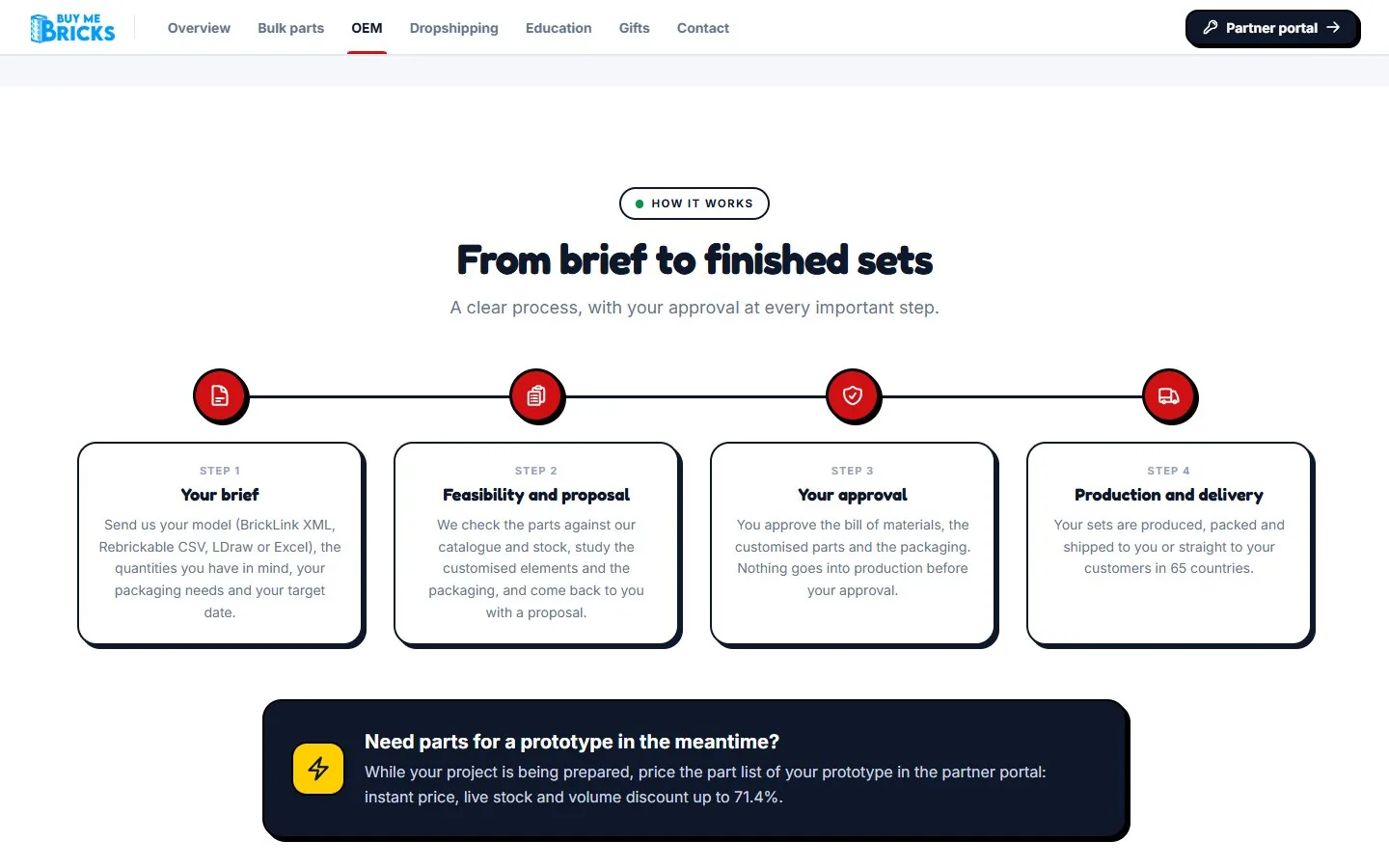
Don't want to hold stock? With dropshipping, we pack each order and ship it straight to your customer in one of 65 countries, under your brand. It's a good way to test a market before you commit to a warehouse.
Your 90-day launch plan
| When | Brand & audience | Product & operations |
|---|---|---|
| Days 1–15 | Niche, buyer profile, name shortlist, trademark search, handles secured. | Design the hero set in Studio with a stock-only palette. |
| Days 16–30 | Logo and one-page style guide. Start posting work in progress three times a week. | Order 5–10 prototype sets. Time the build with first-time builders. |
| Days 31–45 | Launch the email sign-up with a free mini-build. Publish a free MOC in your style. | Fix the instructions. Build the cost stack. Request safety certificates. |
| Days 46–60 | Shoot hero and lifestyle photos. Contact reviewers. Announce the launch date. | Choose the run size and tier. Design the packaging. Set up your store and shipping. |
| Days 61–75 | Countdown content, behind the scenes, a Discord preview for early fans. | Order the production run. Prepare customer service answers. |
| Days 76–90 | Launch. Email the list three times. Share every customer build photo. | Ship, collect reviews, track the six numbers below, plan the add-on set. |
The 6 numbers to watch
- Gross margin per set after parts, freight, packaging and fees. If it's under 50% selling direct, you have no room for ads, discounts or retailers.
- Customer acquisition cost: what you spend on marketing divided by new customers. It must stay well below the margin per set.
- Conversion rate of your product page. Below 1% usually means the photos, price or trust signals need work.
- Repeat purchase rate. Brick fans collect. If nobody buys a second set within six months, your range or your community needs attention.
- Email list growth per week. It predicts your next launch better than follower counts.
- Sell-through: how fast a production run sells. It tells you when to reorder, and how big the next run should be.
Ready to build your brand?
Validate your style with a MOC, then order prototypes and production runs at partner prices, from one set to thousands.
FAQ
How much money do I need to start a brick brand?
Less than most people think, because you don't need moulds. You can validate a design for free as a MOC, then order a handful of prototype sets at partner prices. The big spend comes with your first production run and packaging, and you choose its size. Many brands start with a run of a few hundred sets and grow from there.
Can I use the word "compatible" with another brand's name?
It's risky. Using another company's trademark in your product name or advertising can lead to listings being removed or legal letters. "Compatible with major brick brands" gives buyers the information they need without leaning on someone else's name.
Do I need safety certification if my sets are for adults?
Usually yes. Building sets with small parts are generally treated as toys, whatever the age mark on the box. Plan for EN 71 / CE in Europe and ASTM F963 / CPSIA in the US. BuyMeBricks can provide certificates for the parts it supplies on request.
Should I launch on a crowdfunding platform or my own store?
Crowdfunding works well for an ambitious first set when you already have an audience, because backers finance the run. Pre-orders on your own store keep more margin and the customer relationship. Brands often crowdfund the first set and sell the next ones directly.
How do I stop my design from being copied?
You can't stop every copy, but you can make yours the one people want: a strong brand, a trademark, great instructions, a recognisable style and a community that knows where the original comes from. Register your trademark, and keep building the next set.
Can I sell without holding any stock?
Yes. With dropshipping, BuyMeBricks packs each order and ships it to your customer in one of 65 countries, so you can sell before investing in a warehouse.


 Buy parts on BuyMeBricks · ~$24.50