
Every brick fan has had the thought: "This design is good enough to sell in a box." A few years ago that meant finding a factory, negotiating minimums you couldn't afford and filling a garage with stock. Today you can go from one MOC to a boxed product with your name on it, without a factory and without guessing. This is the playbook we'd follow ourselves, phase by phase, with the numbers to watch at each step.
The playbook in one line per phase
- Validate: publish the design and see whether people actually buy it.
- Prototype: order a small batch at partner prices and test it with real builders.
- Do the maths: build your cost stack before you set a retail price.
- Produce: order your first run at volume prices.
- Make it yours: custom parts and your own box with OEM & private label.
- Sell & ship: from your warehouse, or straight to your customers.
Phase 1: Validate demand before you spend a cent
The cheapest market research in the brick world is to publish the design and watch what happens. List it on the BuyMeBricks MOC Store and builders can order the parts plus your instructions in one click. That costs you nothing, and you can even earn 85% of a designer fee on each sale.
Your creator dashboard then shows views, sales and earnings per design. That's real data on what people want:
- Lots of views, few sales? The idea interests people but the price, photos or description don't convert yet.
- Steady sales with no promotion? You may have a product.
- Comments asking "do you sell this boxed?" That's your signal.
New to publishing? Start with our guide: How to sell your MOC.
Phase 2: Prototype with a small batch
Before you commit to hundreds of sets, build a few. Once your partner access is approved, you can price and order any quantity, even one set, and partner prices start at 50% below our shop prices from the very first set.
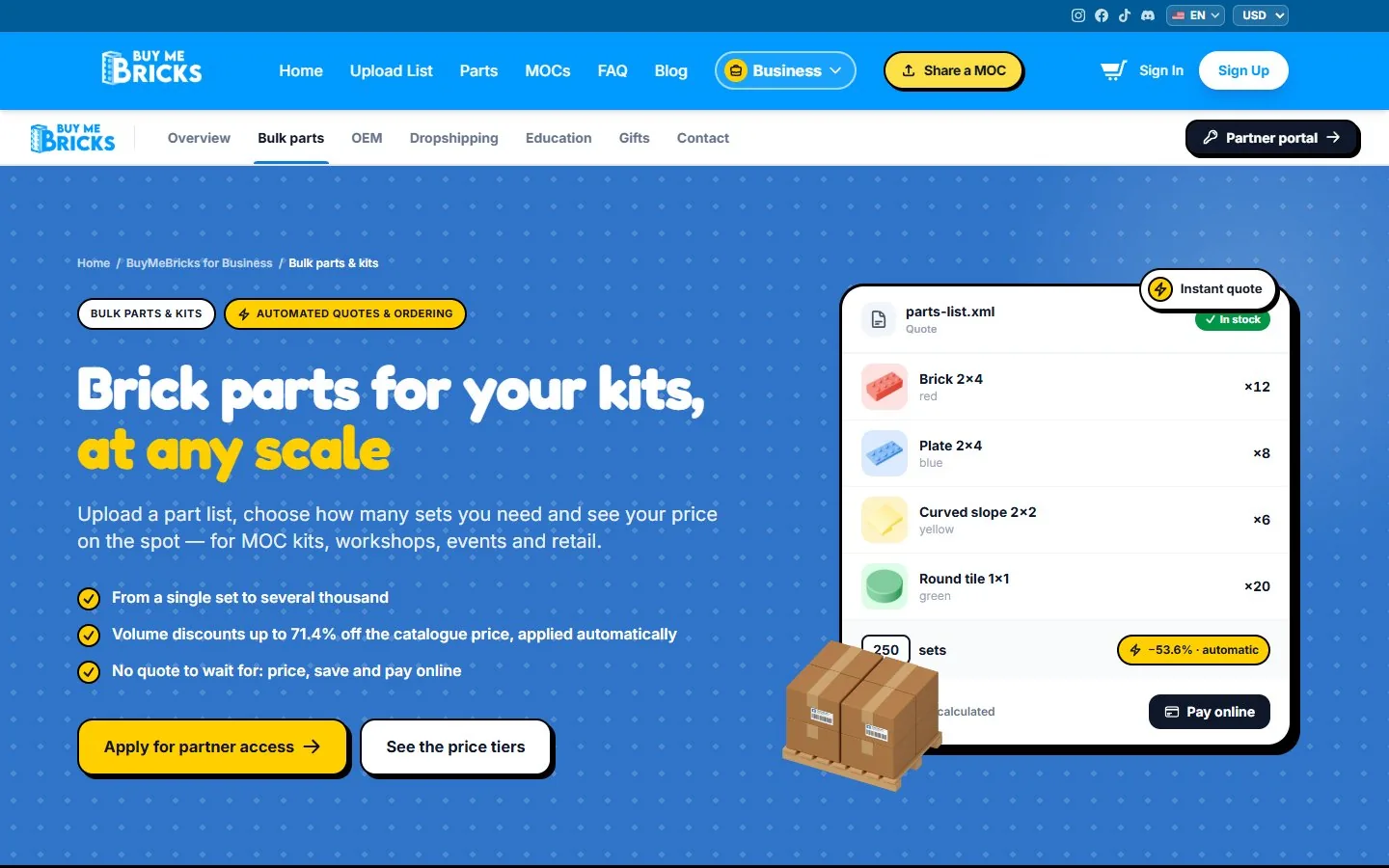
Use the prototype batch to:
- Time the build. Hand it to five people who have never seen it. Where do they get stuck?
- Stress-test it. Does it survive being picked up, shipped and played with?
- Check every part. Anything the catalogue can't supply is flagged before you order, so you can swap it now rather than mid-production. Designing in Studio? Our Studio palette tutorial keeps you inside what we stock.
- Shoot your product photos. You'll need them for your store anyway.
Phase 3: Build your cost stack
Most first-time kit brands price from a gut feeling and discover their margin after the first hundred sales. Do it the other way round: list every cost per kit, then set the retail price.
| Cost per kit | Where it comes from | Example |
|---|---|---|
| Parts | Partner portal quote for your run size | $18.57 |
| Freight to you | Calculated in the quote from weight and destination; divide by number of kits | your quote |
| Packaging | Box, bags, insert (or our OEM packaging) | your supplier |
| Instructions | Printed booklet, or a PDF/QR code (nearly free) | $0 – $3 |
| Sales channel fees | Your marketplace or payment provider's percentage | % of price |
| Shipping to your customer | Charged to them, or absorbed into the price | your choice |
| = Your floor price | Add your margin on top | → retail |
The parts line is the only one that drops sharply with volume. The example above is a 400-piece kit that costs $40 at our shop prices, ordered at 250 sets (−53.6%). That's why the run size you choose in Phase 4 matters so much. Our bulk pricing guide has the full tier table and worked example.
Phase 4: Your first production run
The volume tiers apply to the number of sets of the same part list in one order:
| Sets | 1–100 | 101–499 | 500–999 | 1,000–1,999 | 2,000+ |
|---|---|---|---|---|---|
| Off shop price | −50% | −53.6% | −57.1% | −64.3% | −71.4% |
How big should the first run be? Big enough to reach a tier that makes your cost stack work, small enough that you can sell through it without a warehouse full of unsold boxes. Many brands start in the 101–499 tier and move up once sales are proven. Quotes stay editable until you pay, so you can compare run sizes side by side and reorder later with one click.
Phase 5: Make it yours with OEM & private label
Standard parts in a plain bag make a kit. Custom parts in your own box make a product. Our OEM & private label service covers:
- Parts counted and packed set by set, ready to sell.
- Customised parts for the details a standard catalogue can't cover.
- Packaging in your brand identity, so the set reaches your customers as your product.
- Delivery to your warehouse, or directly to your customers in 65 countries.
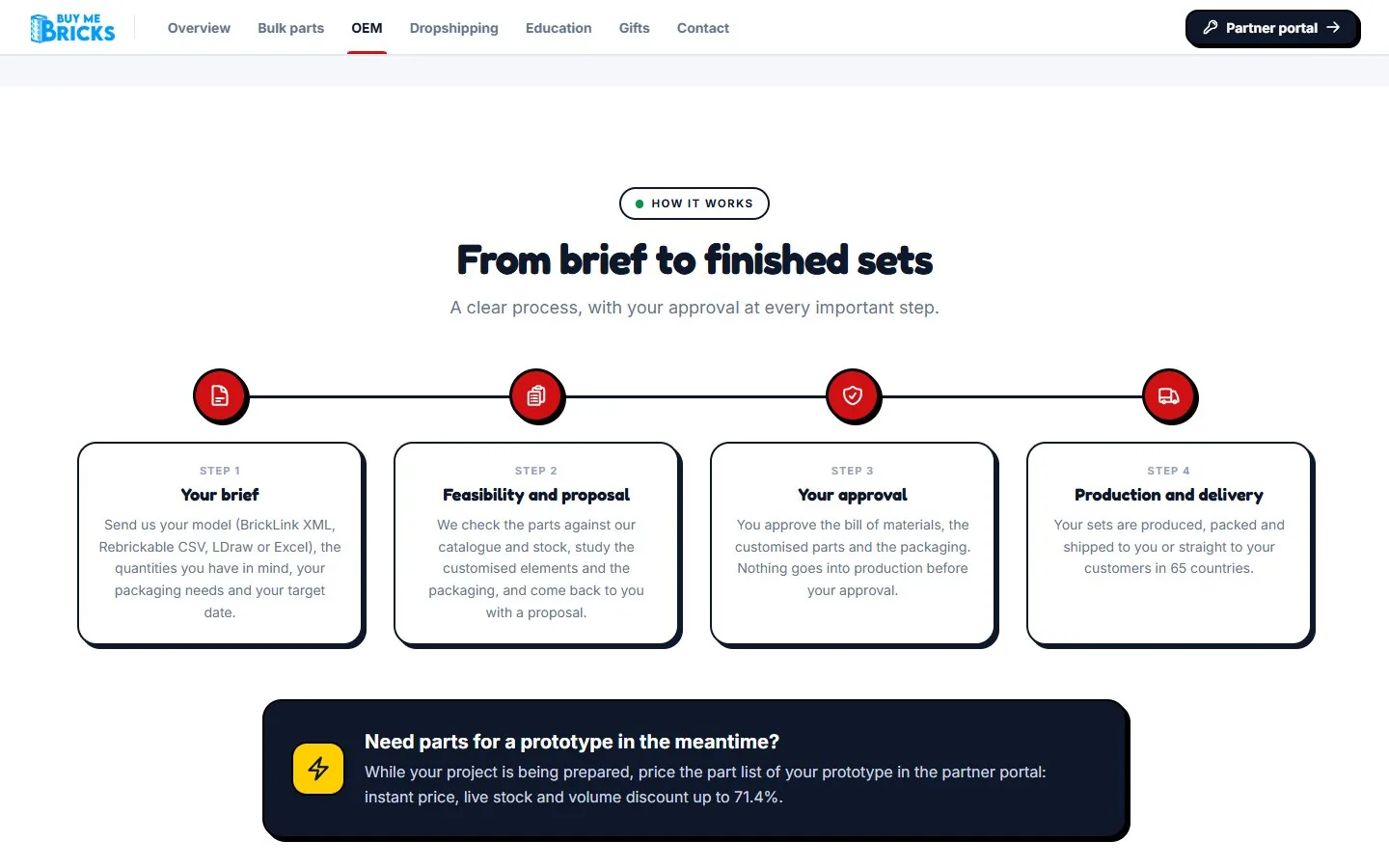
How an OEM project runs
- Your brief. Send your model, the quantities you have in mind, your packaging needs and your target date.
- Feasibility and proposal. We check the parts against our catalogue and stock, study the customised elements and the packaging, and come back with a proposal, including the schedule and the minimum quantity for your project.
- Your approval. You approve the bill of materials, the customised parts and the packaging. Nothing goes into production before that.
- Production and delivery. Your sets are produced, packed and shipped to you or straight to your customers.
📋 Your OEM brief checklist
- Your model or part list (BrickLink XML, Rebrickable CSV, LDraw or Excel). A sketch or photos work too, if that's all you have.
- Target quantities (a range is fine)
- Customised parts you have in mind (printed elements, special shapes)
- Packaging: box, bags, inserts, your brand guidelines
- Delivery country and target date
Minimums and lead times depend on the customised parts, the packaging and the quantities, so we set them out clearly in the proposal rather than quoting a one-size-fits-all number. And you don't have to wait: while your OEM project is being prepared, you can keep ordering prototype parts in the partner portal.
Phase 6: Sell and ship, with or without stock
Two models work well:
📦 Hold stock
Receive your run at your warehouse (or your spare room) and ship orders yourself. Best when you also sell at fairs and events.
🚚 Dropship
We pack each order and ship it to your customer in one of 65 countries. You keep the customer relationship, and the order handover is set up with you when you start.
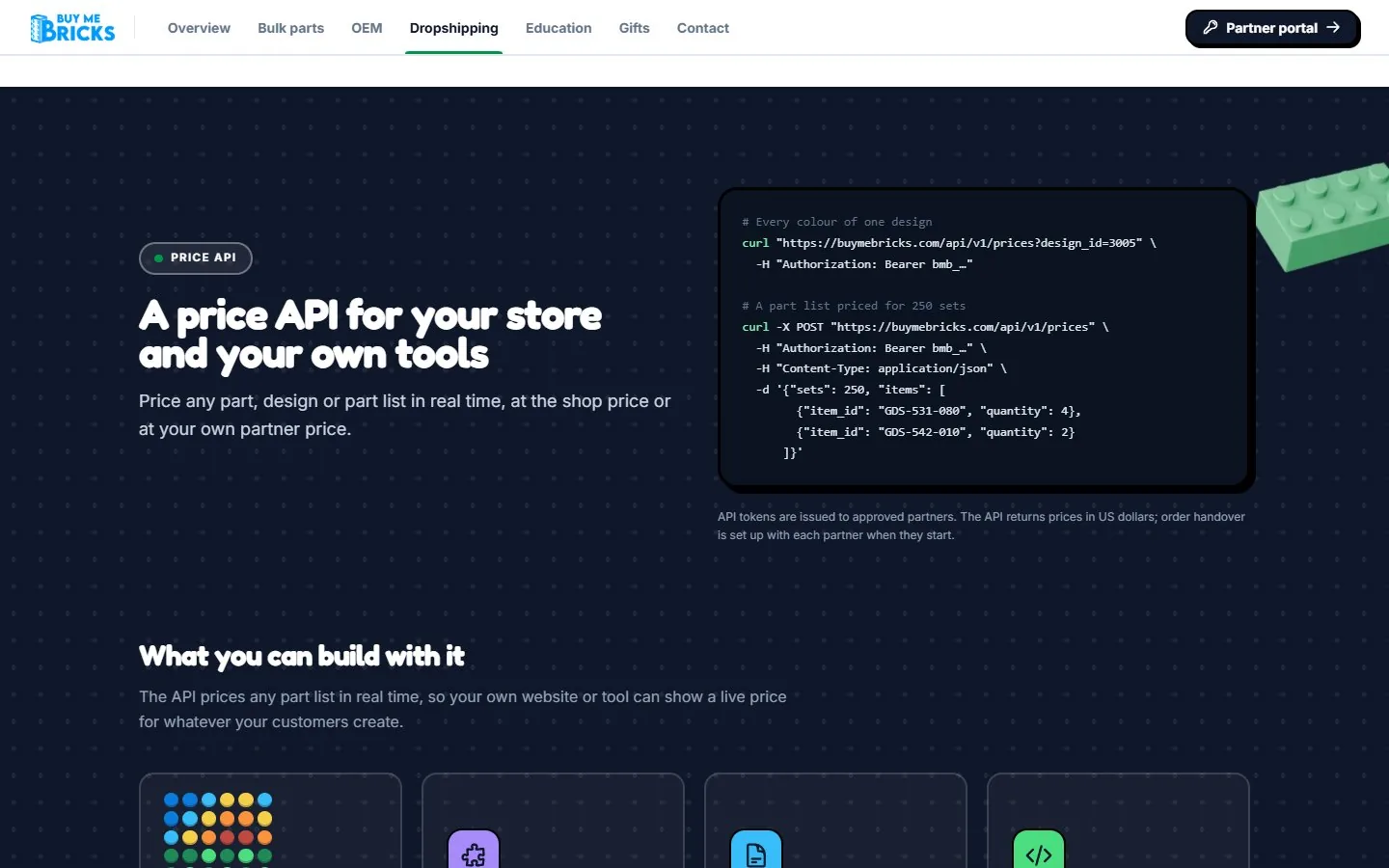
Selling loose parts or customisable kits online? Our price API gives your store our current price for any part, design or list, at your own partner price, so your margins stay under control as the catalogue moves. API tokens are issued by our team to approved partners. See the dropshipping page for details.
7 mistakes that sink first-time kit brands
- Skipping the prototype. One unbuildable step costs you a hundred refunds. Build it five times first.
- Designing with unavailable parts. A rare colour that ran out after your first run means redesigning mid-launch. Design with what's in stock.
- Forgetting shipping in the cost stack. Freight is priced by weight. A heavy baseplate can quietly eat your margin.
- Ordering too big too early. The 2,000-set tier is tempting, but unsold boxes cost money too.
- Borrowing someone else's brand. Never put another company's trademarks, logos or characters on your box or in your product name. It's the fastest way to have a listing removed. Your own name is worth more anyway.
- Treating safety paperwork as an afterthought. Retailers and schools will ask for it. We can provide certificates for EN 71 / CE, ASTM F963, CPSIA and REACH on request, so ask for them early.
- Not reordering in time. Your best seller sells out right before the holidays. Duplicate your last order in the portal and reorder before you run out.
Ready to put your name on the box?
Start with parts in the partner portal, or tell us about your OEM project. Our B2B team will get back to you.
FAQ
Do I need a company to apply for partner access?
Partner access is for businesses and organisations that buy bricks professionally: kit and MOC brands, shops, schools, associations, companies and agencies. Tell us about your activity in the application and our team reviews each request.
What is the minimum quantity for an OEM set?
It depends on the project, in particular on the customised parts and the packaging. We set it out clearly in our proposal.
Can the box carry my brand only?
Yes, that's the whole point of private label: the set and its packaging carry your brand.
Can I start with standard parts before going OEM?
Of course. Many projects start with bulk parts ordered through the partner portal; customised parts and packaging can come later.
Can you ship directly to my customers?
Yes. We can deliver to your warehouse or ship each order directly to your customers in 65 countries.


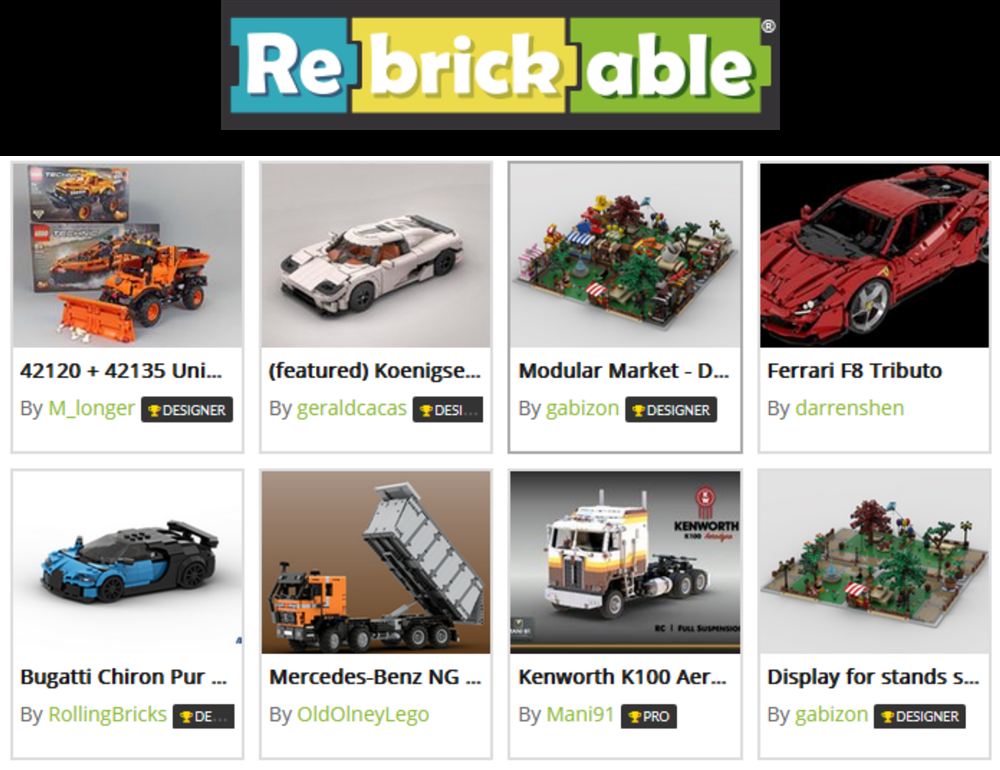
 Buy parts on BuyMeBricks · ~$24.50